Six Fingers and Melted Toes: Why AI Image Generators Still Struggle With Anatomy
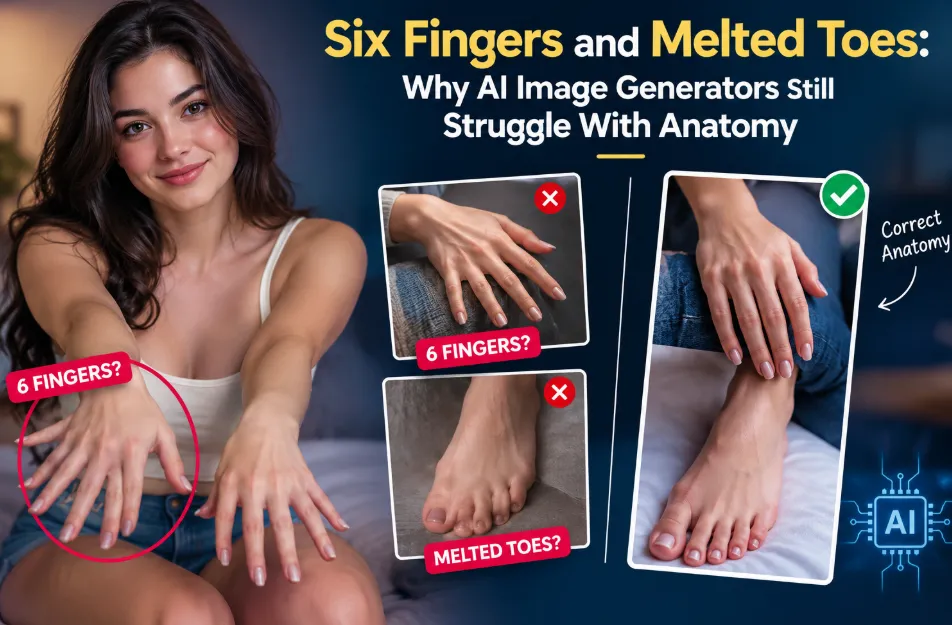
AI image generators can produce a photorealistic face in seconds, then give the same person six fingers. The hands-and-feet problem has become a running joke, and a quick way to spot generated images. It is worth understanding why it happens, because the reasons also explain which generators handle bodies well and which don’t.
Faces are easy, extremities are hard
Image models learn from enormous numbers of pictures. Faces appear constantly in that data, usually front-on and well lit, so the model sees millions of consistent examples. Hands and feet are different. They appear partly hidden, at odd angles, holding things, overlapping each other, or cropped out entirely.
The model never builds a firm idea of the structure underneath. It learns that hands are “a cluster of finger-shaped things” rather than “exactly five digits with joints that bend one way.” When it generates a hand, it produces something plausible at a glance that falls apart on inspection.
Feet are even worse. They appear less often than hands, are frequently covered by shoes, and their arches, toes and soles change shape dramatically with pose. That is why generated feet so often show the wrong number of toes, impossible bends or a smeared, melted look.
Why it matters more in some genres than others
For a landscape or a portrait, a slightly wrong hand is a minor flaw. In adult imagery, anatomy is usually the point of the picture, so errors are fatal rather than cosmetic. Fetish content shows this most clearly. When feet are the subject of the image, a generator that cannot render them properly is useless, which is why specialised tools treat anatomy as a core requirement. You can see that approach described at https://cherrybaeai.com/guide/ai-feet-porn.
The same applies to exaggerated body types. Push proportions beyond average and general-purpose models tend to produce balloon-like shapes and physics that look wrong.
How better generators fix it
There is no single trick, but the improvements tend to come from four places:
1. Targeted training data. Models fine-tuned on images where the relevant anatomy is visible and correct learn its structure rather than its rough shape.
2. Pose awareness. Some pipelines estimate a body’s skeleton first, then render around it, which stops limbs and digits from merging.
3. Character consistency. Generating the same character repeatedly from a stable reference keeps proportions identical across a set of images.
4. Animating approved stills. Video and GIFs amplify every error. The more reliable approach is to pick a still where the anatomy is right, then add motion to it rather than generating motion from scratch.
Platforms built as an adult image generator rather than a general art tool tend to combine several of these.
How to spot the difference yourself
Zoom in. Count fingers and toes. Check where limbs meet the body and whether joints bend the right way. Look at the edges where skin meets clothing or another body. A good generator survives that inspection; a weak one only works at thumbnail size.
If you want to compare results from a generator built with anatomy in mind, you can try one here.