Future Skills Students Need to Succeed in the Digital Economy
The global economy is rapidly evolving due to technological advancements, digital transformation, and the increasing influence of automation and artificial intelligence. As industries adapt to these changes, the skills required in the workforce are also shifting. Students preparing for future careers must develop a combination of technical knowledge, critical thinking abilities, and interpersonal skills to succeed in the digital economy.
The digital economy is driven by technology, data, and innovation. Organizations are seeking professionals who can understand emerging technologies, analyze information effectively, and adapt to changing work environments. For students, developing future-ready skills is essential to remain competitive and relevant in an increasingly digital world.
Understanding the key skills needed for the future can help students prepare for opportunities in various industries and contribute to innovation and economic growth.
Digital Literacy and Technology Awareness
Digital literacy has become one of the most essential skills for students in the modern world. It involves the ability to use digital tools, software platforms, and online resources effectively. Students must be comfortable working with computers, mobile devices, and cloud-based systems that are commonly used in professional environments.
Beyond basic computer skills, digital literacy also includes understanding how technology works and how it can be applied in different industries. Students who are familiar with digital platforms, online collaboration tools, and data systems are better prepared for modern workplaces.
Technology awareness also involves understanding emerging innovations such as artificial intelligence, data analytics, cybersecurity, and automation. By gaining exposure to these technologies early, students can develop confidence in navigating digital environments and adapting to technological changes.
Critical Thinking and Problem-Solving Skills
In the digital economy, information is abundant, but the ability to analyze and interpret that information is what truly matters. Critical thinking enables students to evaluate data, identify patterns, and make informed decisions. Employers value individuals who can approach problems logically and develop practical solutions.
Problem-solving skills are particularly important in industries where technology is constantly evolving. Professionals often face complex challenges that require creativity, research, and collaboration to resolve.
Students who practice analytical thinking, question assumptions, and explore multiple perspectives can develop stronger decision-making abilities. These skills not only improve academic performance but also prepare students to handle real-world challenges effectively.
Communication and Collaboration in Digital Workplaces
Communication skills remain a fundamental requirement in every professional field. In the digital economy, communication often takes place through online platforms such as video conferencing, collaborative software, and digital messaging tools.
Students must learn how to express ideas clearly in both written and verbal forms. Effective communication helps teams share information, coordinate tasks, and achieve common goals.
Collaboration is equally important because many modern projects involve working with diverse teams across different locations. Students who develop teamwork skills, cultural awareness, and the ability to collaborate virtually will have a significant advantage in global workplaces.
Creativity and Innovation
Creativity is becoming increasingly valuable in an economy driven by technology and innovation. While machines and automation can perform routine tasks, creative thinking remains a uniquely human strength. Students who can generate new ideas, design innovative solutions, and think outside traditional frameworks are highly valued by employers.
Innovation often arises from combining different fields of knowledge. For example, technology professionals may collaborate with designers, marketers, and researchers to create new digital products and services.
Encouraging creativity in education allows students to explore new possibilities, experiment with ideas, and develop unique perspectives. These abilities play an important role in entrepreneurship, product development, and technological innovation.
Data Literacy and Analytical Skills
Data has become one of the most valuable resources in the digital economy. Organizations collect and analyze large amounts of information to make strategic decisions, improve services, and understand customer behavior. As a result, data literacy is an increasingly important skill for students.
Data literacy involves understanding how data is collected, interpreted, and used in decision-making processes. Students should learn basic analytical skills, including reading charts, interpreting statistics, and identifying meaningful insights from information.
Even in non-technical fields, professionals are expected to work with data-driven tools and reports. Students who develop strong analytical abilities will be better equipped to participate in data-based decision-making in their future careers.
Adaptability and Lifelong Learning
Technology is evolving at an unprecedented pace, which means that many future jobs may require skills that do not yet exist today. Adaptability has therefore become one of the most critical qualities for success in the digital economy.
Students must be willing to continuously learn and update their knowledge as industries change. Lifelong learning involves staying curious, exploring new subjects, and embracing opportunities for professional development.
Educational institutions are increasingly encouraging students to adopt flexible learning habits, such as online courses, digital certifications, and self-directed study. By developing a mindset focused on continuous improvement, students can remain competitive in a rapidly changing world.
Emotional Intelligence and Human Skills
While technology plays a major role in the digital economy, human-centered skills remain essential. Emotional intelligence refers to the ability to understand emotions, manage interpersonal relationships, and respond thoughtfully in social situations.
Professionals with strong emotional intelligence are better at resolving conflicts, building trust, and maintaining positive workplace relationships. These skills are particularly important in leadership, management, and collaborative roles.
Students who develop empathy, self-awareness, and strong interpersonal communication abilities are more likely to succeed in professional environments where teamwork and leadership are required.
Conclusion
The digital economy is transforming industries, creating new opportunities, and reshaping the skills required for future careers. Students preparing for this evolving landscape must develop a combination of technical knowledge, analytical abilities, and human-centered skills.
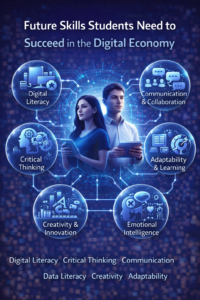
Digital literacy, critical thinking, communication, creativity, data literacy, adaptability, and emotional intelligence are among the most important competencies for success in the modern workforce. These skills enable students to navigate technological change while contributing meaningfully to innovation and economic growth.
By focusing on continuous learning and skill development, students can position themselves for success in a world where technology and human creativity work together to shape the future.
Read more : digisoftron.com